PNG or JPEG for split tiles
A cut is exact in every format. What differs is what the encoder does to each tile afterwards — and that is what shows when the tiles are laid side by side again.
The cut is not the problem
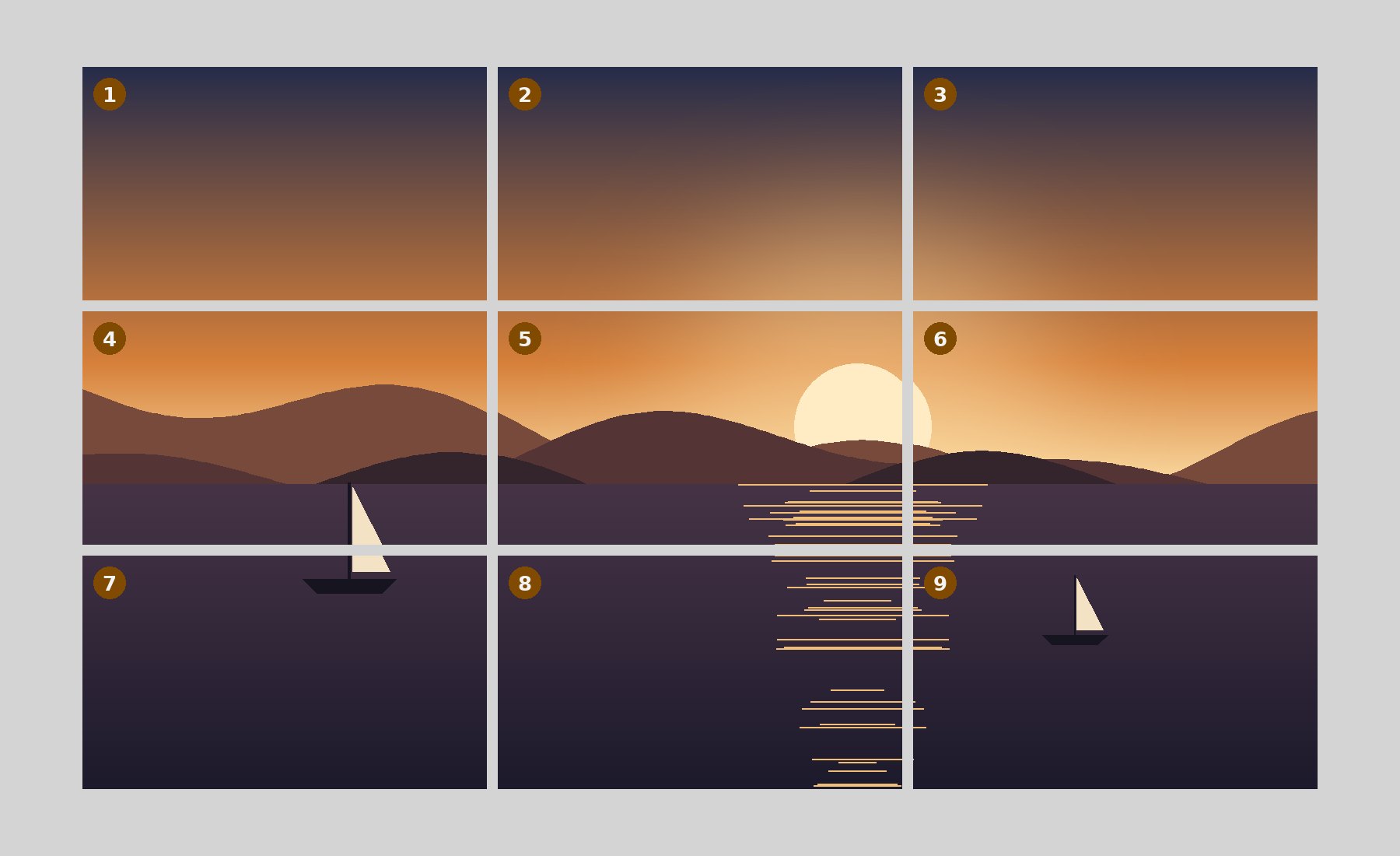
Every tile is drawn from the picture at whole-pixel offsets with smoothing off, so before encoding the nine tiles of a 3 × 3 are exactly the picture’s pixels. Then each one is encoded on its own. PNG is lossless: what goes in comes out. JPEG and WebP are lossy and work in blocks; each tile’s blocks start at that tile’s own corner, so the small errors the encoder makes are arranged differently on either side of every seam. In a busy photograph nobody can see it. In a smooth sky it can show as a faint line where two tiles meet.
Measured
Measured on 24 October 2026 in Chromium 153 with the board’s own reassembly check, which decodes every written tile and compares it with the picture pixel by pixel. The fixture is a 1500 × 1000 picture of a smooth gradient over fine noise — close to the worst case for seams — cut into a 3 × 3 grid.
| Format | Largest difference | Mean difference | Archive |
|---|---|---|---|
| PNG | 0/255 | 0.00/255 | 1.6 MB |
| JPEG, quality 92 | 9/255 | 1.44/255 | 173 KB |
| JPEG, quality 82 | 9/255 | 1.67/255 | 73 KB |
| WebP, quality 82 | 8/255 | 1.81/255 | 24 KB |
The largest difference is the single worst channel value anywhere in the nine tiles; the mean is over every pixel. PNG comes back identical — 0 differing pixels out of 1,500,000 — which is the point of it. The lossy formats move colours by one or two levels on average and by at most eight or nine anywhere, invisible on its own; raising JPEG quality from 82 to 92 more than doubled the archive and barely changed the worst case. Where those few levels land on a smooth area at a tile edge is where a seam can show.
Which to choose
Choose PNG when the tiles will be reassembled by software, stitched back into a poster, used as textures or kept as an archive: it is the only format the reassembly check can call identical, at the cost of much larger files. Choose JPEG when the tiles are going to a platform that re-encodes everything anyway — a profile grid, a carousel — where the platform’s own compression dwarfs the difference between quality 82 and 92. WebP sits between them where it is supported.
These are measurements of one fixture in one browser on one date, not a guarantee. Run the check on your own picture after any export — the button appears under the result — and it reports the same numbers for your tiles.
Open it on the board
- SplitPicture Cut one picture into an exact grid of separate files.
- Split into tiles Tiles of an exact pixel size, with a named rule for the pixels left over.
- Profile grid Three columns of 3:4 tiles uploaded as 4:5, and the order they have to be posted in.
- Split for printing A poster across A4 or A3 sheets: finished size, margins, overlap, trim marks and DPI.